Proposal Tool for Consultants: Scope, Retainers and Faster Approvals
A practical guide for independent consultants and boutique firms: proposal structure, pricing models, scope control and online approval in one place.
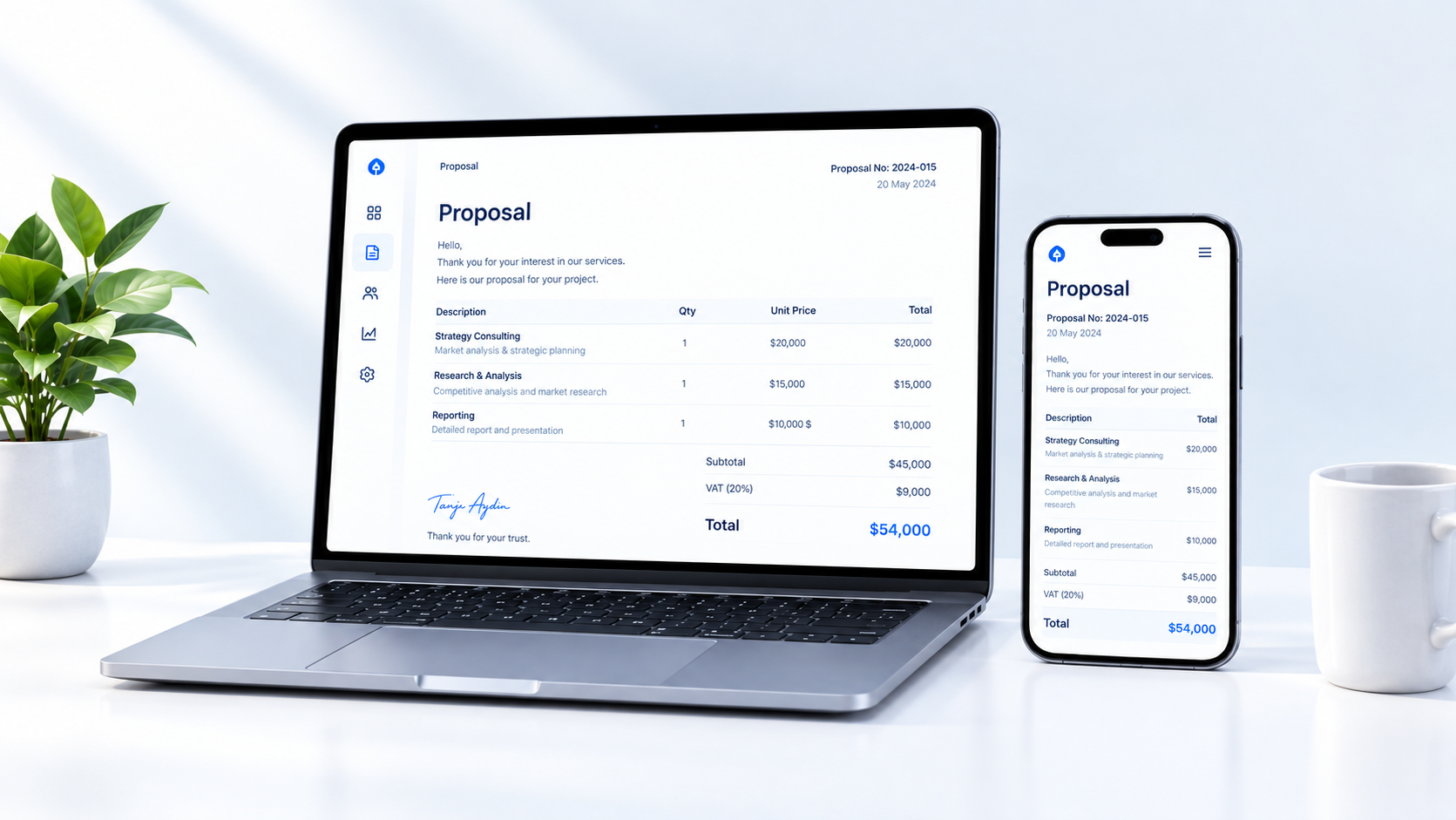
A proposal tool for consultants is software that lets a consultant present scope, timeline, fees and terms in one professional document, see when the client opens it, and collect approval online. A strong consulting proposal has five core parts: the client's problem, the proposed approach, a clear scope, a pricing model and a single approval step.
Consultants sell expertise and time, not physical goods. The proposal must therefore answer "what do I get, how long will it take and what will it cost" without ambiguity. This guide shows independent consultants and boutique firms how to speed up their proposal process step by step.
Why consulting proposals are different
For products, a price list is often enough. In consulting every project is unique and the client buys an intangible outcome. That creates three risks:
- Vague scope: Broad phrases such as "strategic support" turn into unlimited requests.
- Price objections: When value is not explained, clients compare hourly rates only.
- Slow decisions: A PDF gets lost in email and you never know who read it.
4 pricing models for consultants
| Model | Best for | What to state in the proposal |
|---|---|---|
| Hourly / daily | Work with unpredictable scope | An estimated hour range and a cap |
| Fixed project fee | Clearly defined deliverables | Deliverables and number of revisions |
| Monthly retainer | Ongoing advisory and support | Monthly hours/deliverables and rollover rules |
| Value-based | Projects with measurable business outcomes | Expected gain using the client's own numbers |
In Flowpare you can add line items in hours, days, months or your own custom units, and combine a fixed kickoff package with a monthly retainer in the same proposal.
The structure of a winning consulting proposal
1. Executive summary
The decision-maker often missed your meeting. Summarise the problem, approach, expected outcome, total investment and timeline in one paragraph.
2. The client's situation
Restate the problem in the client's own words. It proves you understood the need.
3. Approach and phases
Split the project into phases such as discovery, analysis, implementation and reporting, each with a duration and deliverable.
4. Clear scope and out-of-scope
The most effective way to prevent scope creep is to state what is not included. Example: "This proposal covers two strategy meetings and one report per month; additional meetings are billed hourly."
5. Pricing and options
Offer two or three options (e.g. Essential, Standard, Comprehensive). Options shift the client's question from "yes or no" to "which one".
6. Terms and approval
Keep payment schedule, validity period and cancellation terms short, and leave one clear approval step.
Online proposal or PDF?
PDF is fine for archiving and formal attachments, but it tells you nothing after sending. An online proposal shows you when the client opens it, reads well on mobile and can be approved in one click. With Flowpare you share a live link and can still download a PDF.
How Flowpare helps consultants
- Reusable, customisable templates: Design your cover, about, scope and pricing pages once and reuse them.
- Flexible units: Hour, day, month or custom units, with automatic tax and discount calculations.
- Live tracking: Get notified when a proposal is opened and follow up at the right moment.
- Email and WhatsApp sending: Share through the channel your client answers fastest.
- Online approval and e-signature: Clients can accept with their name and a drawn signature; IP, device and timestamp are recorded.
- Revision requests: Clients can ask for changes and revisions are tracked side by side.
- Customer records: See every client's proposal history in one place.
Note: Flowpare's drawn e-signature is designed as a commercial acceptance record and is not a qualified electronic signature.
Consulting proposal checklist
- Does the first paragraph start with the client's problem?
- Are scope and out-of-scope items written down?
- Are the pricing model and units clear?
- Did you offer at least two options?
- Are validity and payment schedule stated?
- Can the client approve in one click?
- Is your follow-up plan ready for when it is opened?
Conclusion
In consulting, the proposal is the first tangible sample of your expertise. Clear scope, understandable pricing and an easy approval step raise your win rate and reduce disputes during the project. Try Flowpare for free and build your first consulting proposal in minutes.