B2B Sales Funnel Guide: Lead-to-Close Timelines, Benchmarks and Strategies
Every stage of the B2B sales funnel from speed to lead to proposal follow-up, FOMO and closing: ideal timelines, conversion benchmarks, dos and don'ts.
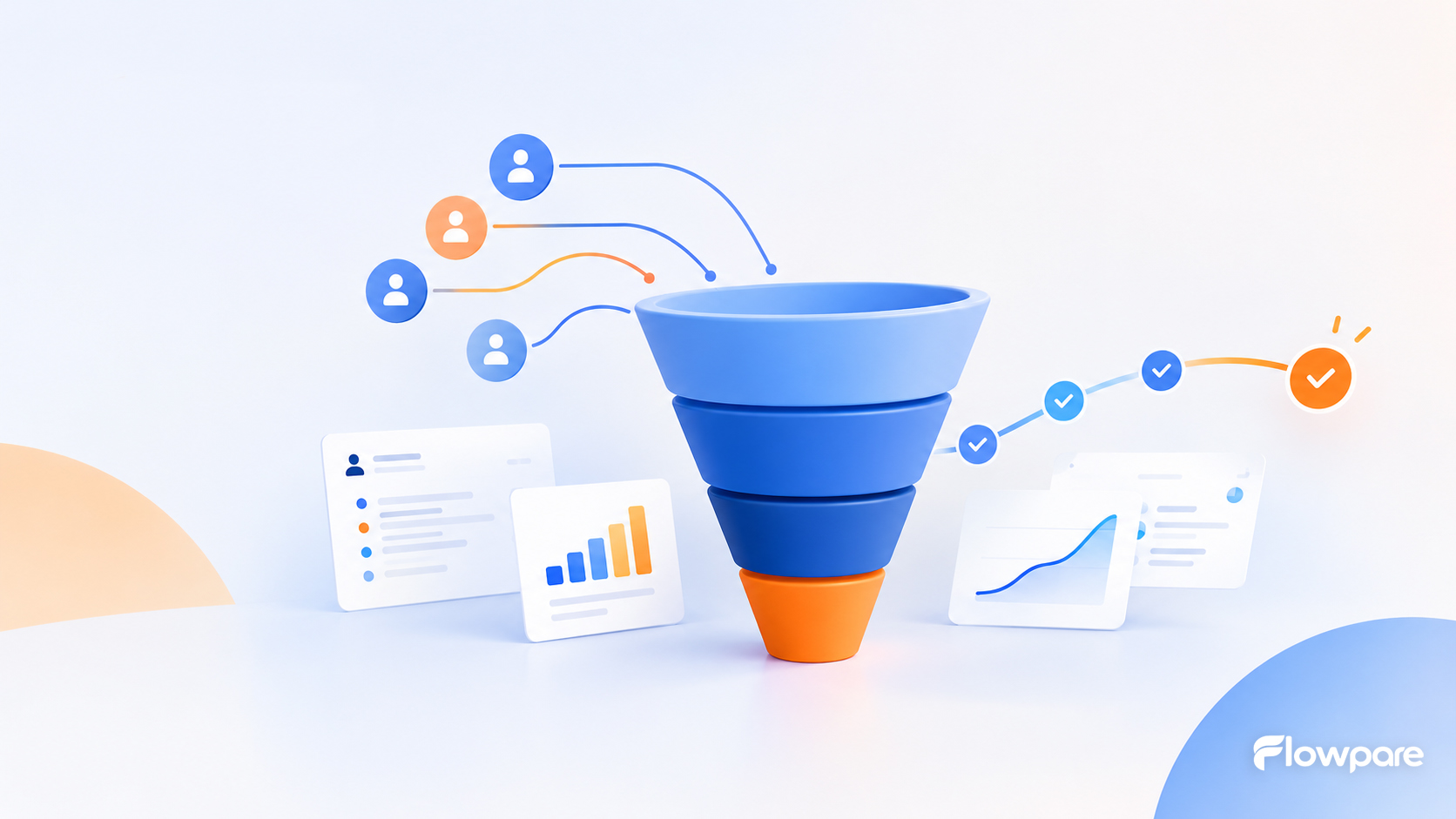
Short answer: A B2B sales cycle typically takes 14–30 days for SMB deals and 3–9 months for enterprise deals. The three variables that shorten it most are speed to lead, the gap between discovery and proposal, and follow-up discipline after the proposal is sent.
Many businesses blame lost deals on price or a stronger competitor. B2B sales research tells a different story: a large share of deals are lost not to a rival but to indecision and a stalled process. This guide covers the ideal timing, conversion benchmarks, dos and don'ts, and practical strategies for every stage from lead to close.
B2B Sales Funnel Benchmarks: Timelines and Drop-off Points
The table summarizes typical values frequently cited in industry research. Numbers vary by industry and deal size; use them as a baseline to compare against your own data.
| Stage | Typical Time | Industry Benchmark | Main Breaking Point | Best Action |
|---|---|---|---|---|
| 1. Lead → First Contact | 0–5 minutes | Most buyers go with the first vendor to respond | After 1 hour, qualification odds drop sharply | Instant personal email/WhatsApp + calendar link |
| 2. Qualification (MQL → SQL) | 1–3 days | Roughly 25–30% of leads are sales-ready | Spending time before budget and decision-maker are clear | Fast filtering with BANT or MEDDPICC |
| 3. Discovery → Proposal | 2–4 business days | About half of qualified opportunities reach proposal | Generic packages that ignore the buyer's pain | Personalized proposal within 48 hours of the call |
| 4. Proposal → First View | First 24 hours | Most proposals are opened on day one | Heavy PDFs failing on mobile, spam folders | Mobile-friendly online proposal shared as a link |
| 5. Follow-up → Negotiation | 7–30 days | Most deals close after 5+ touches | Most reps stop after 1–2 follow-ups | Follow-ups timed to view notifications |
| 6. Decision → Close | 1–5 days | Typically 20–30% of sent proposals are accepted | Wet signatures and print-scan-send loops | One-click online approval and a clear expiry date |
1. Lead Capture and Qualification: Speed to Lead
Key metric: First response time. A study published in Harvard Business Review found that companies responding within an hour were many times more likely to qualify a lead than those responding later.
- ❌ Don't: Let inbound requests sit in the CRM for 24 hours or rely only on an automated "we received your form" email.
- ✅ Do: Reply personally within 5–15 minutes: "Hi John, I got your request — does 10:00 tomorrow work for a quick call?"
- 🎯 Retargeting: Show case studies and customer results via LinkedIn/Meta retargeting to visitors who viewed pricing or feature pages but didn't convert.
2. Proposal Delivery: Static PDF or Online Proposal?
Key metric: Open rate and time spent on mobile. Many decision-makers open a proposal on their phone first; a table that needs pinch-zooming ruins the first impression.
- ❌ Don't: Attach a heavy PDF with ten pages of company history and pricing buried at the end.
- ✅ Do: Lead with scope, solution and investment. Share a link that reads well one-handed on mobile and shows optional items clearly.
| Criterion | Static PDF Attachment | Online Proposal Link |
|---|---|---|
| Mobile readability | Requires zooming | Fits the screen |
| Knowing it was opened | Unknown | Instant notification |
| View history | None | Date, time, device and repeat views |
| Approval | Print-sign-scan | One-click online approval |
| Revisions | New files, mixed versions | Revision requests and comparison |
3. Follow-up: Stop Guessing in the Dark
The silence after sending a proposal is the hardest moment in sales — stuck between "Am I being pushy?" and "Am I losing the deal?"
Blind follow-up: Calling three days later to ask "Did you get a chance to look at our proposal?" The buyer usually says "Not yet" and keeps control.
Data-driven follow-up: You get notified the moment the buyer opens or revisits the proposal. Within 15 minutes: "Hi John, I wanted to clarify one detail on the delivery timeline — do you have five minutes?"
Recommended follow-up cadence
| Day | Channel | Value in the message |
|---|---|---|
| 0 (send) | Email + WhatsApp | Proposal link and a two-sentence summary |
| First view | Phone | Questions and scope confirmation |
| Day 3 | A similar customer's result | |
| Day 7 | Phone / LinkedIn | Other people involved in the decision |
| Day 14 | Expiry date reminder |
4. FOMO and Expiry Date Psychology
"This proposal is valid for 15 days" alone creates no urgency. Back the deadline with a real, verifiable reason:
- Capacity: "We have two project slots left next month; this proposal is reserved for 7 days."
- Cost/FX: "Unit prices are locked until month-end due to licensing and material costs."
- Visible expiry: A clearly displayed expiry date on the proposal page reduces procrastination.
Fake scarcity destroys trust; use FOMO only when a real constraint exists.
5. Closing: Remove Approval Barriers
The print → stamp/sign → scan → email-back loop costs days, and another priority can land on the buyer's desk in the meantime. One-click online approval and drawn signatures make it easier to record the decision the same day.
3 Silent Deal Killers
- Giving up too early: Most reps stop after one or two follow-ups, while most B2B deals close after many touches.
- Approval friction: Waiting for a physical signature cools the decision.
- Selling in the dark: Not knowing whether the proposal was opened weakens your negotiating position.
Checklist for B2B Sales Teams
- ☐ Is your first response time under 15 minutes?
- ☐ Can your proposals be read on mobile without zooming?
- ☐ Can you see when and how many times the buyer opened the proposal?
- ☐ Do you know how many devices it was viewed on?
- ☐ Do you have a scheduled follow-up plan that goes past the 5th touch?
- ☐ Is your expiry date based on a real reason?
- ☐ Can your buyer approve the proposal online in one click?
Where Flowpare Fits
Flowpare lets you build a proposal in minutes, send it as a link via email and WhatsApp, and track when, how often and on which devices the buyer viewed it. Buyers can approve with one click or request a revision, and managers keep control through approval hierarchies. Create a free account and send your first proposal today.
Note: Values in the tables are ranges frequently cited in industry research and may differ by industry and deal size.